


Cat Vaccines Explained: What’s Required, Core, and Optional
- Which Cat Vaccines Are Considered Core?
- What Is the FVRCP Vaccine?
- What Is the Kitten FVRCP Schedule?
- Is Rabies Vaccination Required for Cats?
- Why Rabies Vaccination Matters Even for Indoor Cats
- Is the FeLV Vaccine Core or Optional?
- Which Adult Cats Are at Higher Risk for FeLV?
- What Cat Vaccines Are Considered Optional or Non-Core?
- What About the FIV Vaccine?
- Is There a Vaccine for Feline Infectious Peritonitis?
- Do Indoor Cats Need Vaccines?
- Do Adult Cats Need Vaccines Every Year?
- What If an Adult Cat Has No Vaccination History?
- Can a Cat Be Vaccinated While Sick?
- Are Cat Vaccines Safe?
- What Is a Feline Injection-Site Sarcoma?
- How Can You Tell If a Lump After Vaccination Needs Attention?
- Can Vaccine Titers Replace Cat Vaccinations?
- How Does a Veterinarian Decide Which Vaccines a Cat Needs?
- Which Cat Vaccines Are Actually Required in NYC?
- Building the Right Vaccine Plan for Your Cat
- Frequently Asked Questions About Cat Vaccines
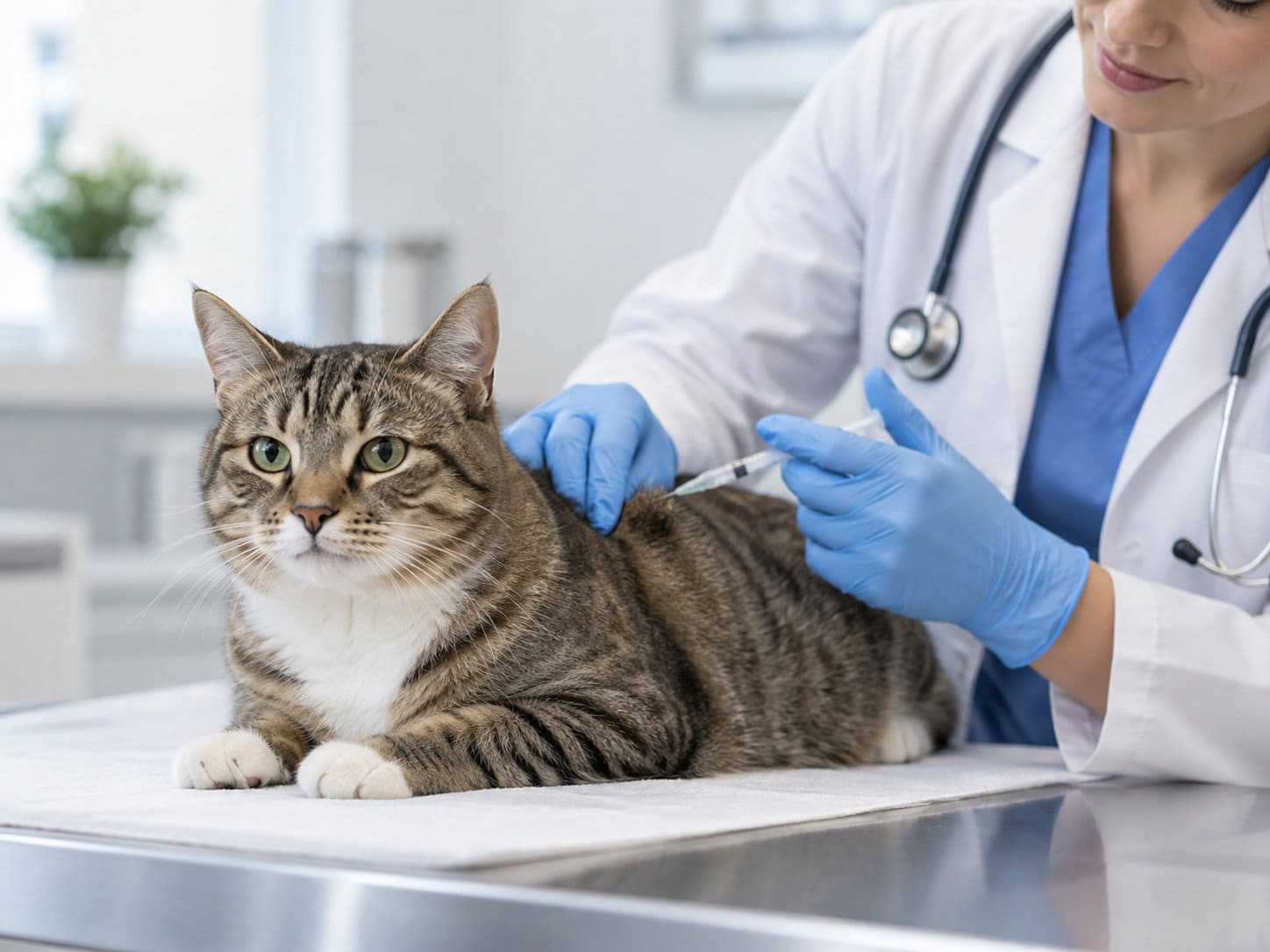
Cat vaccination can seem confusing because not every vaccine falls into the same category. Some are considered core vaccines and are recommended for essentially all cats. Others are given only when a cat's lifestyle creates a meaningful risk of exposure. Rabies is different again because vaccination may also be required by law.
The right vaccine plan therefore depends on more than whether a cat lives indoors or outdoors. Age, previous vaccination history, contact with other cats, travel, boarding, household changes, and local rabies regulations all matter.
A useful way to think about feline vaccination is to separate vaccines into three groups: legally required vaccines, core vaccines, and risk-based or non-core vaccines.
Which Cat Vaccines Are Considered Core?
According to current AAHA/AAFP feline vaccination guidelines, the main core vaccines for pet cats protect against feline herpesvirus type 1, feline calicivirus, feline panleukopenia virus, and rabies. Feline leukemia virus vaccination is also considered core for cats younger than one year because kittens and young cats are particularly susceptible to progressive FeLV infection.
The herpesvirus, calicivirus, and panleukopenia components are commonly combined into a single vaccine known as FVRCP.
Core does not mean that every vaccine is administered every year. It means the disease is important enough that vaccination is recommended broadly, while the actual interval depends on the vaccine, the cat's age, previous doses, and individual risk.
What Is the FVRCP Vaccine?
FVRCP is a combination vaccine that protects against three important feline infectious diseases:
- Feline viral rhinotracheitis, caused by feline herpesvirus type 1;
- Feline calicivirus;
- Feline panleukopenia virus.
Feline herpesvirus and calicivirus are major causes of upper respiratory disease in cats. Depending on the virus and the individual cat, infection can cause sneezing, nasal discharge, eye inflammation, oral ulcers, fever, reduced appetite, and other complications.
Feline panleukopenia is particularly serious. It can cause severe gastrointestinal disease, dehydration, bone marrow suppression, and death, especially in kittens and inadequately vaccinated cats.
Because these infections can be widespread and some pathogens can be carried indirectly on contaminated objects or clothing, even cats that live indoors are not considered completely free of risk.
What Is the Kitten FVRCP Schedule?
Kittens require a series of FVRCP vaccinations rather than a single dose because antibodies received from their mother can interfere with vaccine response during early life.
AAHA/AAFP guidance recommends beginning the series no earlier than approximately 6 weeks of age and repeating vaccination every 3 to 4 weeks until 16–20 weeks of age.
The exact number of doses depends on the age at which vaccination begins and the interval between appointments. The key point is that the kitten should continue receiving appropriately timed doses through the period when maternal antibodies are likely to interfere.
The guidelines also suggest considering an additional FVRCP vaccination at approximately 6 months of age rather than waiting until one year, which may help reduce a potential window of susceptibility in some kittens. After that, revaccination intervals for appropriately vaccinated cats are generally longer, often around every three years depending on the product and individual situation.
Is Rabies Vaccination Required for Cats?
Rabies vaccination is both a medical and legal issue. Requirements vary by state and local jurisdiction, so cat owners should follow the laws where they live.
In New York City, all cats four months of age or older are required to have an up-to-date rabies vaccination unless a valid medical exemption applies. Puppies and kittens should receive their first rabies vaccine by four months of age, and revaccination is required no later than one year after the primary vaccination. Future boosters must then be given at appropriate intervals to maintain active immunization.
This requirement applies to indoor cats as well as outdoor cats. NYC Health specifically notes that indoor pets can still be exposed if they escape outside or if a rabid bat enters the home.
Why Rabies Vaccination Matters Even for Indoor Cats
Owners sometimes assume an indoor cat has no meaningful rabies risk. In reality, indoor living reduces exposure but does not eliminate it.
A cat may escape through an open door or window, become lost during a move, or encounter a bat that enters an apartment or house. Because rabies is fatal once clinical signs develop and can be transmitted to people, prevention carries both individual and public-health importance.
Rabies vaccination also affects what happens legally and medically after a possible exposure. A currently vaccinated cat is managed differently from a cat that has never been vaccinated.
Is the FeLV Vaccine Core or Optional?
The answer depends primarily on the cat's age and exposure risk.
AAHA/AAFP considers feline leukemia virus vaccination core for kittens and young cats under one year of age. Young cats are more susceptible to progressive FeLV infection and its consequences, which can include immune suppression, anemia, and certain cancers.
The initial FeLV series generally consists of two doses given 3–4 weeks apart, beginning as early as approximately 8 weeks of age. Cats should be tested for FeLV infection before vaccination.
After the first year of life, FeLV vaccination becomes risk-based. Adult cats with ongoing potential exposure to FeLV-positive cats or cats of unknown status may continue to need vaccination. Adult cats with no realistic exposure risk may not need ongoing FeLV vaccination.
Which Adult Cats Are at Higher Risk for FeLV?
Exposure risk is higher in cats that go outdoors, live with FeLV-positive cats, interact with cats of unknown status, or live in environments where new cats are frequently introduced.
A previously low-risk indoor cat can also become higher risk if the household changes. For example, adopting another cat with an unknown history, allowing outdoor access, or moving into a multi-cat environment may change the vaccination recommendation.
This is why FeLV vaccination should be reviewed periodically rather than labeled permanently as either “necessary” or “unnecessary.”
What Cat Vaccines Are Considered Optional or Non-Core?
AAHA/AAFP classifies Chlamydia felis and Bordetella bronchiseptica vaccines as non-core. FeLV is also non-core for low-risk adult cats older than one year.
Non-core does not mean unimportant. It means the benefit depends on exposure risk.
Chlamydia felis Vaccine
Chlamydia felis is primarily associated with conjunctivitis and respiratory disease, particularly in multi-cat environments.
The vaccine is not routinely recommended for the average household cat. It may be considered as part of disease-control efforts in environments where infection has been confirmed, such as certain multi-cat households or breeding populations.
Protection is incomplete, so vaccination is not a substitute for appropriate diagnosis, treatment, hygiene, and population management.
Bordetella bronchiseptica Vaccine
Bordetella vaccination is also not routinely used in most pet cats.
It may be considered in specific high-risk multi-cat environments when Bordetella infection has been identified and vaccination is being used as one part of a broader control program.
As with Chlamydia vaccination, the decision should be based on an actual risk assessment rather than simply adding another vaccine to every cat's routine schedule.
What About the FIV Vaccine?
Feline immunodeficiency virus vaccination is an area where older online information can be misleading.
FIV vaccines have historically been discussed as an option for some cats, but an FIV vaccine is not part of the current routine feline vaccination recommendations in the United States. Owners should not assume that FIV vaccination is a standard preventive option simply because they find references to it on older veterinary websites.
Reducing exposure to potentially infected cats, particularly preventing fighting and bite wounds, remains an important part of FIV prevention.
Is There a Vaccine for Feline Infectious Peritonitis?
A vaccine against feline infectious peritonitis, or FIP, has existed, but AAHA/AAFP lists FIP vaccination in the category of vaccines that are not generally recommended. This classification reflects limited evidence of meaningful field benefit relative to routine use.
This is different from saying FIP itself is unimportant. FIP is a serious disease. The issue is whether routine vaccination provides enough demonstrated benefit to justify recommending it broadly.
Do Indoor Cats Need Vaccines?
Yes. Indoor status alone is not a reason to stop core vaccination.
Indoor cats can escape, travel, require boarding, encounter another animal introduced into the household, or be exposed indirectly to certain infectious agents. Rabies exposure is also possible if a bat enters the home.
However, indoor status is relevant when deciding whether some risk-based vaccines are needed. A stable adult cat living entirely indoors with no contact with cats of unknown FeLV status, for example, has a different FeLV exposure profile from a cat that regularly goes outdoors.
The correct approach is not “indoor cats need every vaccine” or “indoor cats need no vaccines.” Core protection remains important, while non-core vaccines should reflect actual exposure risk.
Do Adult Cats Need Vaccines Every Year?
Not necessarily.
Different feline vaccines have different durations of immunity and revaccination recommendations. For appropriately vaccinated cats, FVRCP boosters may eventually be given at approximately three-year intervals rather than annually. Rabies intervals depend on vaccine labeling and local law. FeLV boosters depend on age, product, and continuing exposure risk.
An annual veterinary visit therefore should not automatically mean that every vaccine is repeated each year.
Instead, the veterinarian should review vaccination history, determine which vaccines are actually due, and reassess whether the cat's lifestyle has changed.
What If an Adult Cat Has No Vaccination History?
Cats adopted as adults sometimes arrive without reliable medical records. In that situation, the veterinarian should develop a catch-up vaccination plan rather than assuming the cat is protected.
The exact FVRCP schedule depends partly on the type of vaccine used. AAHA/AAFP guidance allows one or two doses of certain modified-live combination vaccines in cats first vaccinated after 16 weeks of age, while inactivated formulations generally require two initial doses 3–4 weeks apart.
Rabies vaccination should be brought into compliance with applicable law, and FeLV vaccination should be considered according to age and exposure risk. FeLV testing is recommended before vaccination.
Can a Cat Be Vaccinated While Sick?
Vaccination decisions should take the cat's current health into account.
A mild condition does not automatically make vaccination unsafe, but significant illness, fever, immune suppression, or certain treatments may affect whether vaccination should be given immediately or delayed.
This is one reason vaccination appointments should include a health assessment rather than treating vaccines as a simple injection-only service.
The veterinarian can weigh the urgency of vaccination against the cat's current condition and determine the appropriate timing.
Are Cat Vaccines Safe?
Most cats tolerate vaccination well. Mild temporary effects can include tiredness, reduced appetite, low-grade fever, or soreness at the injection site.
More serious reactions are uncommon but require prompt veterinary attention. Difficulty breathing, facial swelling, repeated vomiting, collapse, or rapidly worsening weakness after vaccination should be treated as urgent symptoms.
Owners should also monitor injection sites. Persistent or enlarging masses deserve veterinary evaluation rather than being ignored indefinitely.
What Is a Feline Injection-Site Sarcoma?
Feline injection-site sarcoma is a rare but serious tumor that can develop at sites where injections have previously been administered.
The condition is uncommon, and the existence of this risk does not mean cats should avoid necessary vaccination. Instead, feline vaccination guidelines emphasize giving vaccines only when indicated, choosing appropriate vaccine intervals, documenting injection sites, and using standardized administration locations.
The overall vaccination decision should weigh the small risk of a serious adverse event against the potentially much greater risk posed by preventable infectious disease.
How Can You Tell If a Lump After Vaccination Needs Attention?
A small area of temporary swelling can occur after an injection, but owners should not assume that every persistent lump is normal.
Veterinarians commonly use the “3-2-1” approach when evaluating post-injection masses: further investigation is recommended if a mass remains for approximately three months, is larger than about two centimeters, or continues increasing in size one month after the injection.
If you notice a new lump after vaccination, record when you first found it and let your veterinarian know if it persists or grows.
Can Vaccine Titers Replace Cat Vaccinations?
Antibody titers may have a role in selected situations, particularly when assessing immunity to feline panleukopenia. However, titers do not provide an equally useful substitute for every feline vaccine.
For herpesvirus and calicivirus, antibody levels do not necessarily correspond closely enough with protection to replace routine vaccination decisions.
Rabies is particularly important because legal requirements are determined by local regulations. A rabies antibody result generally does not replace legally required vaccination for a pet cat in New York City.
How Does a Veterinarian Decide Which Vaccines a Cat Needs?
A useful vaccination plan begins with an individualized risk assessment.
The veterinarian considers the cat's age, previous vaccination history, health status, whether the cat lives indoors or outdoors, contact with other cats, travel, boarding, household composition, and local infectious-disease risks.
These factors should be reassessed regularly because a cat's lifestyle can change. AAHA/AAFP recommends reviewing exposure risk at least annually.
A kitten that currently lives indoors may later begin going outside. An adult indoor cat may gain a new feline housemate. A family may begin traveling or boarding the cat. Any of these changes can affect the vaccine plan.
Which Cat Vaccines Are Actually Required in NYC?
For most privately owned cats in New York City, the key legal vaccination requirement is rabies. Cats four months of age and older must be actively vaccinated unless a recognized medical exemption applies.
Other vaccines such as FVRCP and FeLV are recommended according to veterinary guidelines rather than because NYC law requires every cat to receive them.
This distinction matters. “Required” describes a legal obligation, while “core” describes a veterinary recommendation based on disease severity, prevalence, and the value of vaccination.
Building the Right Vaccine Plan for Your Cat
There is no benefit in viewing feline vaccination as a choice between “every vaccine every year” and “no vaccines for indoor cats.” Both approaches oversimplify preventive care.
Core vaccines protect against serious diseases that remain relevant even for many indoor cats. Risk-based vaccines should be added when a cat's lifestyle creates meaningful exposure. Rabies vaccination must also comply with local law.
For kittens, vaccination needs are more intensive because maternal antibodies and age-related susceptibility affect the schedule. For adult cats, the focus shifts toward maintaining core protection while avoiding unnecessary vaccination when exposure risk is low.
For cats in Queens and elsewhere in New York City, a veterinarian can review previous records, current lifestyle, and legal rabies requirements and build an individualized cat vaccination plan that provides appropriate protection without treating every cat exactly the same.
Frequently Asked Questions About Cat Vaccines
Which vaccines are considered core for cats?
Core feline vaccines include protection against feline herpesvirus, calicivirus, panleukopenia, and rabies. FeLV vaccination is also considered core for kittens and cats younger than one year.
Do indoor cats still need vaccines?
Yes. Indoor cats still need core protection because they can escape, encounter other animals, or be exposed to certain infectious agents indirectly. Rabies vaccination is also legally required in New York City for cats four months of age and older unless a valid medical exemption applies.
Is the FeLV vaccine required for all cats?
No. FeLV vaccination is strongly recommended for kittens and young cats under one year. In adult cats, the decision becomes risk-based and depends on factors such as outdoor access and contact with cats of unknown FeLV status.
How often do cats need the FVRCP vaccine?
Kittens receive a primary FVRCP series beginning at about 6 weeks of age and continuing every 3 to 4 weeks until approximately 16–20 weeks. After the initial series and appropriate booster, many adult cats can receive FVRCP boosters at longer intervals, often around every three years.
Is rabies vaccination required for cats in NYC?
Yes. Cats in New York City must be vaccinated against rabies by four months of age unless a valid medical exemption applies. The first booster is required no later than one year after the initial vaccination, with future boosters given according to applicable requirements and vaccine labeling.
Does an adult indoor cat need the FeLV vaccine?
Not always. An adult cat that lives strictly indoors and has no realistic exposure to FeLV-positive cats may not need ongoing FeLV vaccination. The recommendation should be reassessed if the cat begins going outdoors or new cats are introduced into the household.
Are Chlamydia and Bordetella vaccines necessary for most cats?
No. These are generally considered non-core vaccines and are mainly used in specific higher-risk situations, such as certain multi-cat environments where the relevant infection has been identified.
Can vaccine titers replace regular cat vaccinations?
Sometimes, but not for every vaccine. Titers may be useful in selected cases, especially for panleukopenia, but they are less helpful for herpesvirus and calicivirus. Rabies titers generally do not replace legally required rabies vaccination in NYC.
What side effects can occur after cat vaccination?
Mild tiredness, soreness, reduced appetite, or a low-grade fever can occur for a short time after vaccination. Difficulty breathing, facial swelling, repeated vomiting, collapse, or rapidly worsening weakness require urgent veterinary attention.