


Microchipping Pets in NYC: Is It Worth It?
- What Is a Pet Microchip?
- Is a Pet Microchip a GPS Tracker?
- How Does a Microchip Help If Your Pet Gets Lost?
- Does Microchipping Really Improve the Chance of Getting a Lost Pet Back?
- Is Microchipping Required in New York City?
- Do Cats in NYC Benefit From Microchipping?
- How Is a Pet Microchip Implanted?
- When Is the Best Time to Microchip a Pet?
- Does Microchipping Hurt?
- Can a Microchip Move Inside a Pet
- Does a Microchip Need a Battery or Replacement?
- Registration Is Just as Important as Implantation
- What If You Don
- What Happens If a Microchip Registry Shuts Down?
- Should a Microchipped Pet Still Wear a Collar and ID Tag?
- What About Microchips for International Pet Travel?
- What Are the Limitations of Microchipping?
- Should You Have an Existing Microchip Checked?
- Is Microchipping Worth It for NYC Pets?
- Microchipping Your Dog or Cat in Queens
- Frequently Asked Questions About Pet Microchipping in NYC
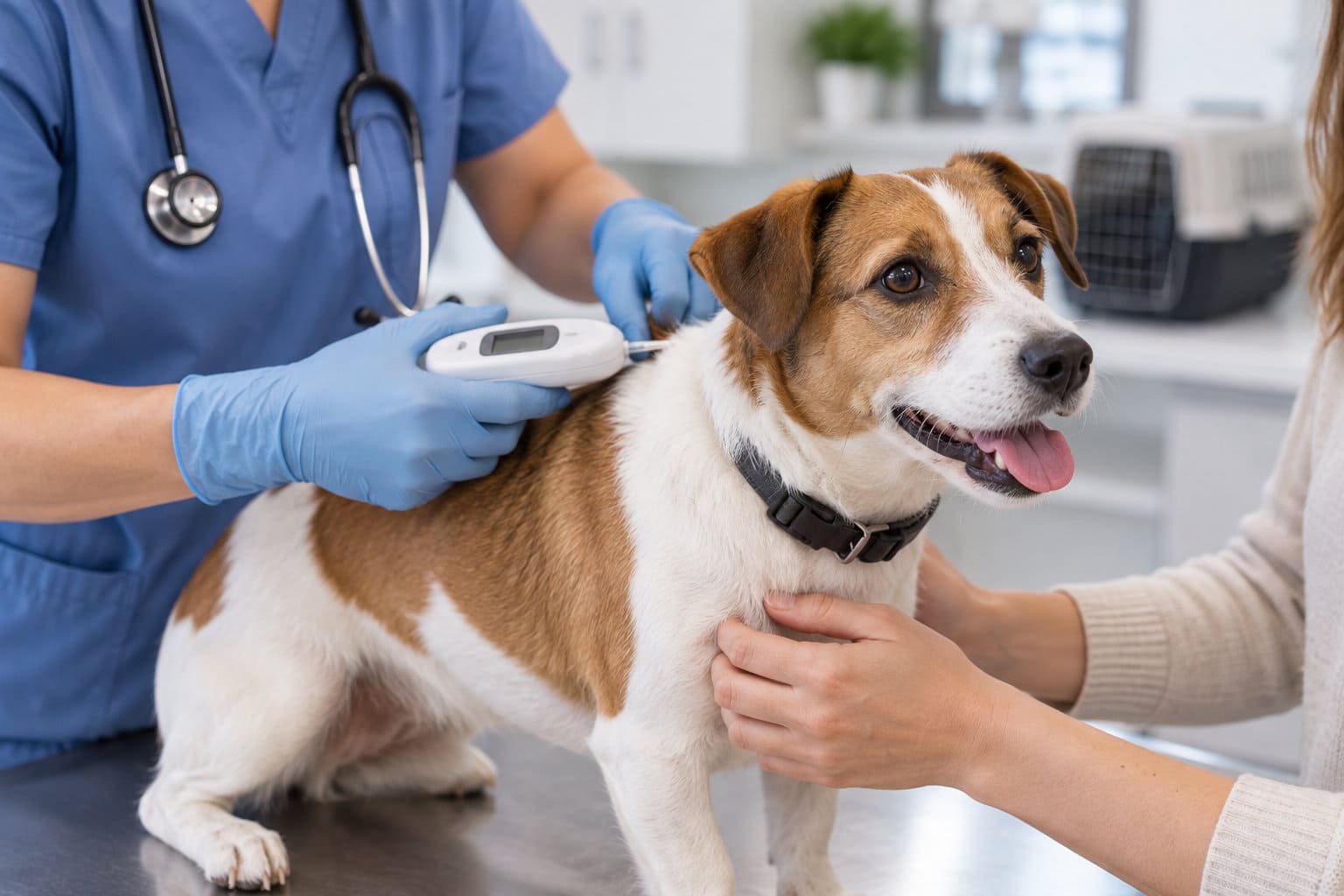
In a city as busy as New York, a dog slipping out of a harness, a cat escaping through an open door, or a pet becoming separated from its owner during an emergency can quickly become a serious problem. Collars and ID tags help, but they can fall off, break, or become unreadable.
A microchip provides a second, permanent form of identification. It cannot tell you where your pet is in real time, but if a lost dog or cat is found and scanned at a veterinary hospital or animal shelter, the chip can help connect that pet back to its owner.
For most pets, microchipping is a quick procedure with a low complication risk and potentially lifelong value. Its usefulness, however, depends on something owners sometimes overlook: the chip must be properly registered and the contact information must remain current.
What Is a Pet Microchip?
A pet microchip is a small radio-frequency identification device implanted under the skin. It contains a unique identification number that can be read with a compatible scanner.
The microchip does not normally contain your name, address, or phone number. Instead, its identification number is associated with a microchip registry where owner contact information can be maintained.
When a lost pet is found, a veterinary hospital, shelter, or animal control organization can scan the animal. If a chip is detected, the identification number can be used to determine which registry holds information associated with it and, when the registration is current, help contact the owner.
Is a Pet Microchip a GPS Tracker?
No. This is one of the most common misconceptions about microchipping.
A standard pet microchip has no GPS receiver, cellular connection, or battery. You cannot open an app and see your pet's location on a map simply because the pet is microchipped.
The chip works only when a scanner is brought close enough to detect it. Its purpose is identification, not location tracking.
If you want real-time or near-real-time location information, that requires a separate tracking device, usually attached to the pet's collar. A tracker and a microchip serve different purposes and can complement each other.
How Does a Microchip Help If Your Pet Gets Lost?
Imagine that your dog escapes in Queens and is found several neighborhoods away without a collar. Someone brings the dog to a veterinary hospital or shelter, where staff scan for a microchip.
If a chip is found, its identification number can be checked through the appropriate registry. The registry information can then be used to help reach you.
New York City specifically advises owners to use identification or microchips to make lost pets easier to reunite with their families, and most veterinary hospitals can scan found dogs and cats for chips.
This is particularly useful when visible identification has been lost. A collar can come off during an escape, but an implanted microchip normally remains with the animal.
Does Microchipping Really Improve the Chance of Getting a Lost Pet Back?
Microchipping cannot guarantee that a lost pet will return home, but the evidence strongly supports its value as an identification tool.
Pets with microchips are more likely to be reunited with their owners than animals without permanent identification. This makes sense clinically and practically: a found animal without a collar may provide no obvious clue about where it came from, while a registered chip creates another path back to the owner.
The benefit disappears, however, if the chip cannot be linked to current contact information. An implanted microchip with an outdated telephone number and address is substantially less useful than one whose registration is maintained correctly.
Is Microchipping Required in New York City?
New York City's microchip rules require some distinctions.
There is not a general citywide rule requiring every privately owned dog or cat to be microchipped simply because the animal lives in NYC. However, certain situations have specific requirements.
Under the New York City Administrative Code, a pet shop or animal rescue group may not release a dog or cat to a purchaser or adopter unless the animal has been microchipped and the chip has been registered with the new owner's contact information.
New York City also requires trained guard dogs to have an implanted microchip as a permanent form of identification.
Dog licensing is a separate requirement. All dogs in New York City must be licensed, and the license tag must be attached to the dog's collar while the dog is in public. A microchip does not replace this licensing requirement.
Do Cats in NYC Benefit From Microchipping?
Yes. Microchipping is not only for dogs.
Indoor cats are sometimes assumed to have little need for permanent identification because they rarely leave the home. In reality, an indoor-only cat may be particularly difficult to recover if it escapes because it may be unfamiliar with the surrounding neighborhood and may hide rather than approach people.
Doors left open by visitors, damaged window screens, moving days, building emergencies, and trips to or from the veterinary clinic can all create opportunities for an indoor cat to become lost.
Unlike dogs, cats also frequently do not wear collars or visible identification. A registered microchip therefore provides an important permanent identification option if the cat is found and taken somewhere that can scan it.
How Is a Pet Microchip Implanted?
The procedure is relatively simple. A veterinarian or trained veterinary professional uses a sterile applicator to place the microchip beneath the skin, typically in the standardized implantation area between the shoulder blades in dogs and cats in the United States.
The procedure takes only a short time and usually does not require general anesthesia. The needle used to implant a microchip is larger than a standard vaccination needle, so a pet may feel brief discomfort, but most tolerate the procedure well.
After implantation, the chip should be scanned to verify that it can be detected and to confirm its identification number.
When Is the Best Time to Microchip a Pet?
Microchipping can be performed during a routine veterinary appointment and does not necessarily require a separate procedure.
Some owners choose to have the chip implanted when their puppy or kitten is young. Others have it done during a wellness appointment or when adopting an adult animal that does not already have a chip.
If a pet is undergoing anesthesia for another appropriate procedure, such as spay or neuter surgery, microchipping can also be performed at that time. This is convenient, although anesthesia is not normally necessary solely for microchip placement.
Adult and senior pets that have never been microchipped can still benefit. There is no practical point at which a healthy older pet becomes “too old” simply because of age.
Does Microchipping Hurt?
Microchip implantation causes a brief needle insertion similar in principle to an injection, although the applicator needle is larger because it must deliver the chip.
Most dogs and cats experience only momentary discomfort. Mild tenderness at the implantation site can occasionally occur afterward.
Serious complications are uncommon. As with any procedure that penetrates the skin, problems such as local inflammation or infection are possible but unusual when the chip is implanted appropriately.
Can a Microchip Move Inside a Pet's Body?
A microchip can occasionally migrate a short distance from its original implantation site. This is one reason scanners are typically passed over a broader area rather than placed at one exact point.
Migration does not automatically mean the chip has failed or needs to be removed. If the chip remains readable and is not causing a medical problem, treatment is generally unnecessary.
AAHA recommends that microchipped pets be scanned during regular veterinary care to confirm that the chip can still be detected and to help verify its location.
Does a Microchip Need a Battery or Replacement?
No. Standard pet microchips are passive devices. They do not contain a battery that needs charging or routine replacement.
The scanner provides the energy needed for the chip to transmit its identification number when it is read.
A functioning chip is designed to provide permanent identification for the pet's lifetime. Routine replacement is therefore not part of normal microchip care.
Registration Is Just as Important as Implantation
Implanting the microchip is only the first half of the process.
The chip's unique number needs to be associated with a reliable registry and accurate owner contact information. Without that link, a shelter or veterinary hospital may find the chip but still have difficulty locating the owner.
After microchipping, make sure you know:
- your pet's microchip number;
- which registry holds the registration;
- how to access and update your account;
- which phone numbers and email addresses are currently listed.
If you move, change telephone numbers, change email addresses, or transfer ownership of the pet, update the registration promptly.
What If You Don't Know Where Your Pet's Microchip Is Registered?
This is a common problem, particularly with adopted pets or animals microchipped many years ago.
Your veterinarian can scan the pet to obtain the microchip number. The number can then be entered into the American Animal Hospital Association's Universal Pet Microchip Lookup Tool.
The AAHA tool does not display an owner's private contact information. Instead, it identifies participating registries that may have information associated with that microchip number. You can then contact the relevant registry to check or update the registration.
Because multiple microchip companies and registries operate in the United States, keeping a personal record of both the chip number and registry can save time later.
What Happens If a Microchip Registry Shuts Down?
This is another reason owners should occasionally verify their pet's registration rather than assuming that implantation alone is sufficient.
A microchip itself can continue functioning even if the company that originally maintained its registration database stops operating. In that situation, the chip usually does not need to be surgically replaced.
Instead, the microchip number may need to be registered with another compatible pet recovery registry. AAHA's lookup system can help determine where a chip is currently registered or whether additional registration may be necessary.
Should a Microchipped Pet Still Wear a Collar and ID Tag?
Yes. A microchip should be considered a backup to visible identification, not a replacement for it.
If someone finds a dog wearing an ID tag with a current phone number, the owner may be contacted immediately without taking the dog somewhere to be scanned.
A microchip becomes especially valuable when the collar or tag is missing, damaged, or removed.
For dogs in New York City, there is another important reason to keep the collar on: city law requires dogs to have a valid license, and the license tag must be attached to the collar while the dog is in public.
What About Microchips for International Pet Travel?
Microchipping can also be important when traveling internationally, but travel rules deserve careful attention.
Many destinations require an ISO-compatible 15-digit microchip, and some countries require the microchip to be implanted or scanned before particular vaccinations or blood tests are performed. The sequence of events can affect whether travel documents are accepted.
Requirements vary by destination and can change, so owners planning international travel should review current entry requirements well before departure rather than assuming that any microchip automatically satisfies every country's rules.
What Are the Limitations of Microchipping?
A microchip is useful, but it is not a perfect recovery system.
It cannot prevent a pet from becoming lost. It cannot show the pet's location. It cannot guarantee that every finder will take the animal somewhere to be scanned, and no scanning system is completely infallible.
Recovery can also fail when a chip was never registered or when the owner forgot to update old contact information.
The strongest identification strategy therefore combines several layers: a secure collar when appropriate, a visible ID tag, required dog licensing, a registered microchip, and updated contact information.
Should You Have an Existing Microchip Checked?
Yes. A pet that was microchipped years ago does not need another chip simply because time has passed, but it is reasonable to confirm that the existing chip can still be detected.
AAHA recommends having pets scanned periodically, including during routine veterinary visits, to verify that the microchip is readable and determine whether it has migrated from the expected location.
This is also a good opportunity to confirm that you still have the correct chip number and that the registry contains current information.
Is Microchipping Worth It for NYC Pets?
For most dogs and cats, microchipping offers substantial practical value for a relatively simple procedure.
New York City presents many situations in which a permanent form of identification can be useful: crowded streets, apartment buildings, dog runs, transportation, boarding, moving, severe weather, fireworks, and other situations in which a pet can unexpectedly become separated from its owner.
The benefit is not that the chip can track your pet. It cannot. The benefit is that if someone finds your pet and brings them to a shelter, veterinary hospital, or other location with a scanner, there is a permanent identification number that may lead back to you even when the collar is gone.
Microchipping works best when it is treated as part of a broader identification plan rather than a substitute for collars, tags, licensing, and responsible supervision.
Microchipping Your Dog or Cat in Queens
If your dog or cat is not microchipped, or you are unsure whether an existing chip is still readable, a veterinarian can scan your pet and discuss the appropriate next step.
At VetQueens Animal Hospital in Rego Park, owners can arrange pet microchip identification and make sure the microchip number is correctly associated with the information needed to help reunite a lost pet with its family.
After the procedure, keep a copy of the microchip number and registry information with your pet's medical records, and remember to update the registry whenever your contact information changes. A microchip is designed to last for years, but the contact information behind it is only useful when it stays current.
Frequently Asked Questions About Pet Microchipping in NYC
Is microchipping required for all pets in New York City?
No. New York City does not generally require every privately owned dog or cat to be microchipped. However, specific rules apply in certain situations, including dogs and cats transferred by pet shops or animal rescue groups and trained guard dogs.
Can a pet microchip track my dog or cat with GPS?
No. A standard pet microchip is an identification device, not a GPS tracker. It can only be read when a compatible scanner is passed near the chip.
How does a microchip help find a lost pet?
If a lost pet is found and scanned, the microchip provides a unique identification number. That number can be connected to a registry containing the owner's contact information, helping a shelter or veterinary hospital contact the owner.
Does a pet microchip need to be registered?
Yes. Implanting the chip is not enough. The microchip number should be registered with accurate owner contact information, and those details should be updated whenever the owner moves or changes a phone number or email address.
Does microchipping hurt dogs or cats?
Microchip implantation causes brief discomfort because the applicator needle is larger than a typical vaccination needle. Most pets tolerate the procedure well, and general anesthesia is usually not required.
Should a microchipped pet still wear an ID tag?
Yes. A collar and visible ID tag can allow someone who finds your pet to contact you immediately. The microchip provides permanent backup identification if the collar or tag is lost or removed.
Can a microchip stop working or move?
Microchips are designed to provide long-term identification and do not require a battery, but they can occasionally migrate from the original implantation site. Having the chip scanned during routine veterinary visits helps confirm that it remains detectable.
What should I do if I do not know where my pet's microchip is registered?
A veterinarian can scan your pet to obtain the microchip number. You can then use the AAHA Universal Pet Microchip Lookup Tool to identify registries that may have information associated with that chip.
Is microchipping worth it for an indoor cat?
Yes. Indoor cats can still escape through doors or windows, become lost during a move or emergency, or get separated from their owners during travel. Because many cats do not wear collars, a registered microchip can provide an important permanent form of identification.